The Room That Says Good Morning Back: An Afternoon with the Town’s Volunteer Broadcasters
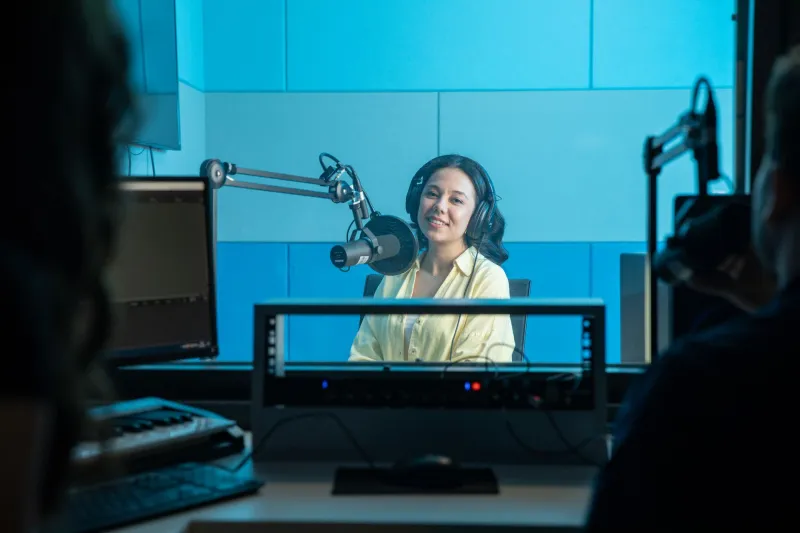
On a grey Tuesday in November, the kind of day that never quite gets light, I climb a narrow staircase beside a shop that sells wool and birthday cards. At the top is a door with a handwritten sign: ON AIR — PLEASE KNOCK QUIETLY. Behind it, a room the size of a generous kitchen holds two microphones, a mixing desk older than some of its volunteers, and a kettle that is, at any given moment, either boiling or being promised to someone.
This is the town’s community radio station. It broadcasts on 87.9 FM to perhaps four miles of streets, and online to anyone who finds it. It has no playlist director, no algorithm, and no interest in what is trending. It has a rota, a biscuit tin, and a presenter called Margaret who is currently reading out the weather as though it were a letter from a friend. ‘Light rain until lunch,’ she says. ‘Then a chance of brightness. Take a coat, love.’
A Studio the Size of a Larder
The station has been going since 2011, which in volunteer years is roughly a century. It began as a hospital radio outfit, moved into a back room at the community centre, and now leases the upstairs of a building that also houses a barber and a firm of solicitors. The lease is paid for by a monthly quiz night and the occasional grant. The equipment has been donated, repaired, or bought second-hand from a station in a city that upgraded to something shinier.
What strikes me first is how quiet it is. Not silent — there is the low hum of the desk, the shuffle of papers, the distant sound of a bus — but quiet in the way a library is quiet. No one is shouting into a microphone. No one is chasing a viral moment. The presenter finishes the weather, plays a song by a local folk trio, and then reads out a notice about a missing cat in the next village. ‘Answers to Biscuit,’ she says. ‘If you see him, ring the studio.’
The News Is the Street
Community radio is often described as ‘hyperlocal’, which sounds like a marketing term. In practice it means the news is the street. A sinkhole on the High Street. A jumble sale at the church hall. A request for a wheelchair to borrow for a week. A dedication from a man called Dave to his wife, who is listening in the car park of the supermarket because she cannot get the signal at home.
There is something quietly radical about this. The station is not trying to be the BBC, though it admires it. It is not trying to be a podcast, though it has one. It is simply a room that says good morning back. When the presenter reads out the lost-property notices — a pair of glasses, a blue umbrella, a single glove — you can hear the town thinking: that could be mine.
The Antidote Is Not Silence, It’s Scale
I have been trying, this year, to notice the difference between noise and volume. Algorithmic feeds are loud in a way that has nothing to do with decibels. They are loud because they are always asking you to react — to be outraged, amused, informed, sold to. The community station asks almost nothing. It offers a weather report, a song, a phone number, and the gentle assumption that you might be doing the washing-up while you listen.
That assumption is the whole point. The broadcast is not a performance for an audience; it is a conversation with a neighbourhood. It is slow because the people making it are not paid by the click. They are paid, if at all, in tea and the satisfaction of a job that no one outside the town will ever notice. And that is precisely why it feels like an antidote. Scale, not silence, is the remedy. A smaller signal is easier to trust.
Five Small Ways to Keep a Local Station Warm
You do not need to start a radio station to support one. Here are some gentler options.
-
Listen deliberately. Tune in for twenty minutes while you make dinner. The numbers matter to funders, and the presenters notice.
-
Send a request or a dedication. It costs nothing and it gives the next hour a shape. The lost-cat notice I heard was followed by three more calls within ten minutes.
-
Offer a skill, not just money. Can you fix a mixing desk? Design a poster? Write a grant application? Stations are often rich in goodwill and poor in admin.
-
Buy a raffle ticket or go to the quiz. The biscuit tin is not a metaphor; it is a funding stream.
-
Write to your MP or local council about community media funding. Quietly, politely, with the station’s name in the first paragraph.
If You Want to Make Your Own Signal
Starting a micro-radio project is more possible than it sounds, but it is not instant. In the UK, a full community radio licence comes from Ofcom and requires a commitment to social gain — training, access, accountability. That can take years. A Restricted Service Licence, for a festival or a one-off month, is a gentler first step. Hospital radio, school radio and online-only stations need no licence at all, though music licensing still applies.
The practical route is usually this: find a room, find three people who will turn up reliably, borrow a microphone, and start with a podcast or an internet stream. Call it a radio station if you like. Read out the weather. Read out the bus times. Let someone else choose the music. The technology is the easy part. The hard part is the rota — and the kettle.
A Small Signal, Held Open
When I leave, Margaret is playing a song from 1974 and reading out a phone number for a lift to the garden centre. The rain has stopped. On the stairs, I pass a volunteer carrying a box of tea bags and a stack of CDs. ‘We’re on till six,’ she says. ‘Tune in.’
I do, in the car. It is not the best signal. It crackles. But for twenty minutes, the town is a place where someone knows about the cat, the sinkhole and the umbrella. That is not a small thing. It is the smallest possible thing, held open on purpose.