The Plane Tree on the School Run: A Year of Looking Up Slowly
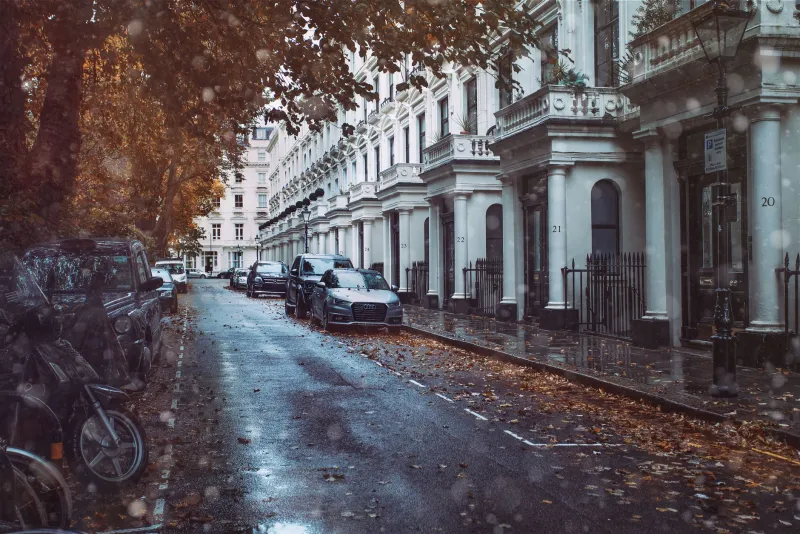
On a grey November morning, the plane tree on the way to the school gate is doing very little. Its leaves are mostly gone, the pavement beneath it is damp, and a few stubborn seed cases hang on like old decorations nobody has got round to taking down. It is not a famous tree. It has no plaque. It is simply there, between a bin and a bus shelter, doing the slow work of being a tree in a British street.
I started noticing it because I was early one day. Not early enough to do anything useful, just early enough to stand still for four minutes. And once you stand still under a tree, you begin to see how much of it you have been missing.
Begin with the tree already in your way
You do not need to find a special tree. In fact, the less special the better. The one outside the corner shop, the one leaning over the school fence, the one in the small square of grass by the car park. Choose the tree you already pass. That is the whole instruction.
This is not a project. There is no chart to fill in, no app to open, no before-and-after photograph to post. The point is not to become an expert in bark or leaf shape, though you may pick up a little of that by accident. The point is to let one ordinary thing become familiar.
A plane tree is a good companion for this because it is generous with change. In winter it is a map of itself: pale, patchy bark, knuckled branches, a silhouette that looks different against a white sky than against a low pink one. In spring the buds come in a way that seems almost too quick. By summer it is a great green umbrella, and by autumn the leaves are coming down in that particular plane-tree way, large and leathery and slightly theatrical.
You do not have to know any of this on day one. You can simply look up.
No app, no tally, no badge
There is a temptation to turn noticing into another thing to be good at. We are a bit like that in the UK: we like a brisk walk, a bit of self-improvement, a small badge of effort. But this practice works better when it stays slightly unimpressive.
Look at the tree when you pass it. That is enough. Some days you will notice the leaves. Some days you will notice that someone has tied a lost glove to the railings nearby. Some days you will notice nothing at all and will simply be a person standing under a tree for thirty seconds, which is not a bad use of thirty seconds.
The repetition is the gentle part. A tree does not need you to be consistent in a disciplined way. It will carry on regardless. You are just dropping in on something that was already happening. There is a quiet relief in that. The tree is not waiting for your report.
What a year of looking actually looks like
In January, the plane tree is mostly structure. You see the way the branches divide and divide again, and you realise how much of the tree is invisible in summer. On frosty mornings the bark looks almost silver. In February, the light starts to come back at the edges of the day, and the tree seems to hold it a little longer than the buildings do.
By March, there are buds, and by April the first leaves are out, small and creased and surprisingly bright. You may notice that the pavement underneath is busier with birds. In May, the canopy starts to close over the street like a slow ceiling. In June, if it is a lime or a plane in flower, there is a faint sweetness in the air that you might not have connected to the tree before.
Summer is the easy part. The tree is a shade, a landmark, a place to wait. In August, after a hot week, the leaves look dusty and tired, and you notice how much a street tree does without anyone thanking it. Then September arrives with that sudden shift in light, and the first leaves begin to turn. October is the great unmaking. November, like now, is the bare bones again.
None of this is dramatic. That is the point. The year does not need to be eventful to be worth noticing.
The street starts to arrange itself around it
Once you have chosen a tree, other things come into focus. You notice which neighbours pass it at the same time as you. You notice the dog that always stops at the same patch of grass. You notice the bus shelter adverts changing, the school posters, the way the council prunes the lower branches and then leaves the rest alone.
A tree becomes a small landmark in the mind. 'Just past the plane tree' is a different kind of direction from 'near the shops'. It makes the street feel less like a route and more like a place. That is a small utopian idea, really: the belief that a neighbourhood can be made of ordinary things that are known and returned to.
You do not have to tell anyone you are doing this. But you might find yourself mentioning the tree to someone at the bus stop, or pointing out the first leaf to a child who is not especially interested. That is fine too. The practice can be private and still leak a little warmth into the day.
A small anchor, not another task
By the time another November comes round, the tree will look more or less like this one: bare, patient, a bit damp. You will have seen it through a year of weather and bin days and school runs and whatever else the street has held. Nothing much will have happened. Everything will have happened.
That is the quiet offer of choosing one tree. It asks nothing from you except that you look up now and then. It gives you a way to measure time without a screen, and a reason to stand still on a pavement you have walked a hundred times. It makes the ordinary feel worth returning to.
And on the grey mornings, when the plane tree is doing very little, that is more than enough.