The Warm Room on the Corner: Forty Minutes Inside the Launderette
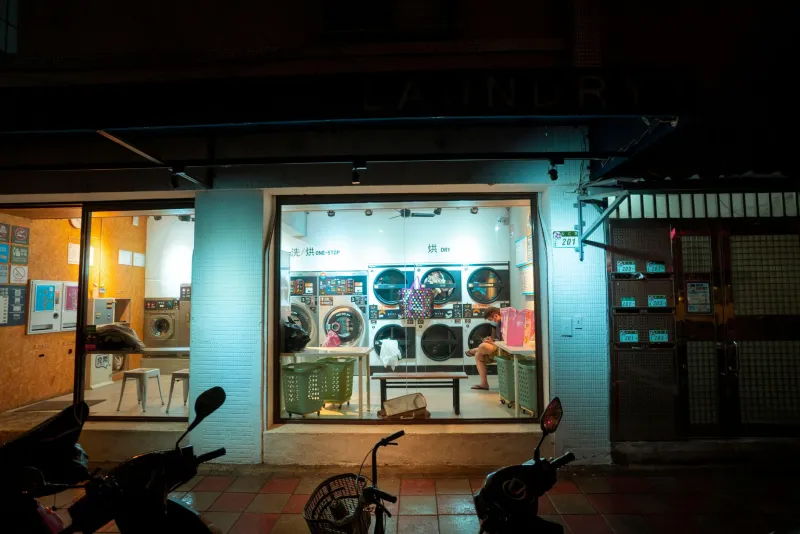
There is a particular kind of warmth that only exists behind a launderette door. It smells of hot cotton and faintly of someone else's washing powder. The window is always slightly fogged. The chairs are the kind that were designed to be sat on for exactly as long as a cycle takes, no longer, and they're bolted in a row so that strangers end up facing the same direction, like passengers on a very slow bus.
I went in on a damp Tuesday in November with a duvet cover and a bag of coins, and stayed for fifty minutes. I had not intended to stay. I intended to drive home, put the kettle on, and come back. Instead I sat down, and something in me let go of a knot I hadn't noticed I was holding.
The appointment nobody makes you keep
A launderette asks very little of you. You turn up. You feed the machine. You wait. Nobody is going to ask how you are, and nobody is going to mind if you tell them anyway.
The etiquette is unspoken but remarkably consistent. You don't take a machine somebody is clearly heading for. You offer the spare dryer to the person hovering with a basket, because you can see they've done the mental arithmetic and come up short. You say "there's a bit left on mine" and mean a pound, or twenty minutes, or a scoop of powder. There's a looser economy in here than the one on the high street outside.
It's one of the few indoor places left in Britain where you can sit for the best part of an hour without buying anything. Not a café, not a library, not a pub. You've already paid for the wash. The sitting is included.
What's actually happening in there
Somewhere between the spin cycle and the tumble dryer, a small amount of community happens by accident. That's the key thing — nobody is organising it.
There was a man folding towels into a shape I'd never seen before, and a woman who told him he was doing it wrong, and then showed him, and then they both laughed the specific laugh of two people who have decided to be friendly for ten minutes and will probably never speak again. There was a student with a wash bag and a look of mild panic, being quietly talked through the dryer settings by someone's nan. There was me, pretending to read my phone.
If you want a picture of how a street actually works — who lives here, who's new, who's struggling, who's fine — you could do worse than sit in a launderette for an afternoon. It's a census conducted entirely in small talk.
The slow disappearance
These rooms are getting rarer. The reasons aren't mysterious: machines at home got cheaper, rents went up, the buildings got bought, the owners got older. High streets across the UK have lost a lot of their launderettes over the past few decades, and the ones that remain often survive on service washes, commercial contracts and sheer stubbornness.
What tends to go first isn't the washing. Most of us can wash things. What goes is the room — the warm, fogged-up, faintly ridiculous room where you sit with your neighbours for forty minutes and don't have to explain yourself.
I don't want to be sentimental about this. Launderettes are not charming little museums. They're businesses, and the people running them are working. Some are tired. Some are hanging on. The service wash is not a quaint ritual; it's a service, often used by people who can't have a machine at home at all — no space, no plumbing, no landlord who'll allow it.
That's the real argument for them, actually. Not nostalgia. Practicality, with a chair.
Small ways to notice the one you have
You don't have to make it a project. There's enough of that about.
- Use it occasionally, even if you don't need to. Duvets, curtains, a rug that's too big for your drum. It's a genuine reason to go, and it keeps a till ringing.
- Take coins. Many are still coin-operated, and the change machine is often the first thing to break. Go prepared and you'll be someone's favourite person by ten past nine.
- Learn the rhythm. Quieter mornings, busier Saturdays. Going when it's calm is a different experience from going when it's a queue.
- Say the small thing. "There's twenty minutes left on mine" costs nothing and is, quietly, the whole point.
- Read the noticeboard. They're often the last place in a neighbourhood where a lost cat, a room to rent, and a keep-fit class all share the same sheet of A4.
- Leave the phone in your pocket for a bit. Not the whole time. Just long enough to notice the sound of the dryers and the fact that you're not doing anything else, and that this is fine.
Forty minutes, unaccounted for
On the way out I held the door for a woman carrying a laundry bag the size of a small child. She said thanks. The cold came in, then the door shut, and the warm room went back to humming.
I drove home with a dry duvet cover on the passenger seat and a slightly unreasonable fondness for a building I'd walked past for years without once looking at. It hadn't changed. I had, a bit — which is roughly what forty minutes of enforced stillness will do.
If there's a launderette near you, it's worth knowing it exists. Not as a memory. As a room you could go and sit in this week, with a bag of coins and nothing else to do.